Christmas lights should be stored coiled loosely in labeled, climate-controlled totes, never crammed into bins or wrapped tightly, which crushes bulbs and kinks wire. Proper storage doubles bulb life, keeps commercial C9 LEDs performing for 5 to 7 seasons, and makes next year's install fast and tangle-free.
The lights come down in January, and what happens next determines whether your holiday investment lasts five seasons or one. Most homeowners cram their lights into a bin, shove it into a cold garage corner, and discover in November that half the bulbs are dead, the wire is kinked, and the whole display is a tangled mess. Proper storage is the difference between lights that perform for years and lights that need replacing every season, and it is the part of the holiday cycle that almost everyone gets wrong. This guide explains how to store Christmas lights the right way, why climate control matters in York Region, and how off-season maintenance protects your investment.
We have spent 3-plus years installing, taking down, and storing holiday displays across Richmond Hill, Vaughan, Markham, Aurora, and Newmarket, and storage is where we see the biggest gap between professional and DIY results. A homeowner who buys commercial-grade lights and stores them poorly gets one or two seasons out of them. A homeowner who stores them properly, or hires a service that does, gets five to seven. The product is the same, the storage is the difference, and this guide gives you the exact method we use so your lights perform for years.
How should Christmas lights be stored to last for years in Richmond Hill?
Christmas lights should be stored coiled loosely in labeled, climate-controlled totes, never crammed into bins or wrapped tightly, which crushes bulbs and kinks wire. Proper storage doubles bulb life, keeps commercial C9 LEDs performing for 5 to 7 seasons, and makes next year's install fast and tangle-free.
The storage principles
- Coil loosely: never wrap tightly, which kinks wire and crushes bulbs.
- Labeled totes: organized by zone so next year's install is fast.
- Climate control: avoid garage temperature swings that degrade product.
- Inspect and test: every bulb and strand checked before storage.
- No crushing: lights crammed into bins get crushed and tangle.
Why storage matters more than you think
Christmas lights are not a buy-once, use-forever product, but they can come close with proper care. The two enemies of stored lights are physical damage and temperature cycling. Physical damage happens when lights are crammed into a bin, wrapped tightly around a spool, or stacked under heavier items, which crushes bulbs, kinks wire, and breaks the internal connections that make the string work. Temperature cycling happens when lights sit in a garage or shed that swings from -20C in January to +40C in July, which expands and contracts the wire and sockets, loosening connections and degrading the insulation.
Climate-controlled storage solves the temperature problem by keeping lights in a stable, moderate environment, and proper coiling and labeling solves the physical damage problem. Together, they extend the life of commercial C9 LEDs from one or two seasons to five to seven, which means the per-season cost of a quality display drops dramatically over time. This is the hidden economics of professional holiday lighting, the storage is what makes the investment pay off, and it is why our full-cycle package includes it.
The two enemies of stored lights
- Physical damage: crushing, kinking, and tangling from poor packing.
- Temperature cycling: garage swings from -20C to +40C degrade wire and sockets.
- Moisture: condensation in unsealed bins corrodes contacts.
- Pests: garage storage invites rodents that chew wire.
The right way to coil and pack lights
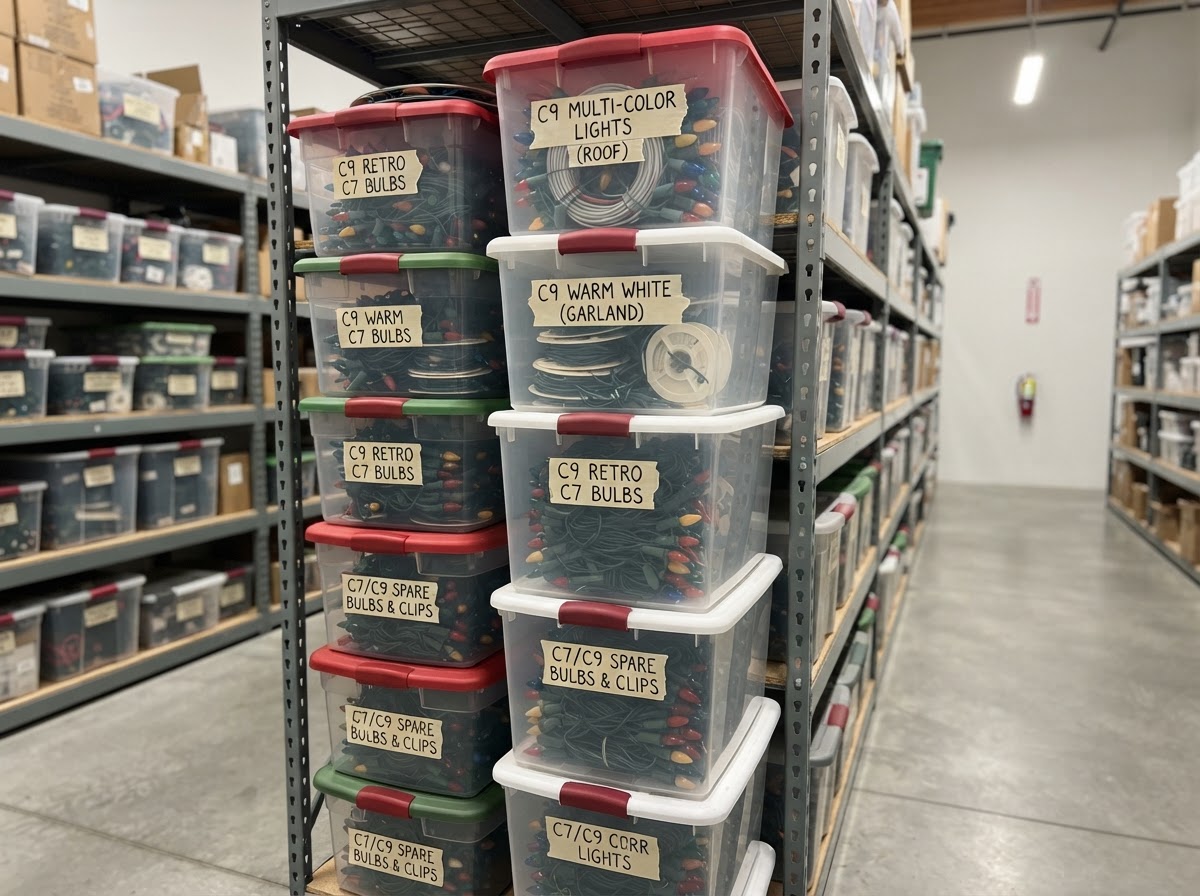
The single biggest storage mistake is wrapping lights tightly around a spool or reel. Tight wrapping puts a permanent kink in the wire, and a kinked wire is a wire that will fail, either immediately or after a season of thermal cycling. The right method is to coil the lights loosely, in a figure-eight or a loose loop, so the wire follows its natural curve without stress. Each coil goes into a labeled tote, organized by zone, so next year's install is fast and the crew knows exactly which run goes where.
We use heavy-duty, climate-rated totes with custom dividers that keep each run separate and protected. Nothing is stacked on top of the lights, nothing is crushed, and every tote is labeled with the zone it serves, the linear footage, and the bulb count. When November comes, the crew pulls the totes, and the install is fast because everything is organized, tested, and ready. That is the difference between a two-hour install and a six-hour install, and it is entirely a function of how the lights were stored.
The right coiling method
- Loose coils: figure-eight or loose loop, never tight wrapping.
- No spools: tight spool wrapping kinks wire permanently.
- Custom dividers: keep each run separate and protected.
- Labeled totes: zone, linear footage, and bulb count on each.
- Nothing stacked on top: crushing is the leading cause of dead bulbs.
Why climate control matters in York Region
York Region's temperature swings are brutal on stored electronics, and Christmas lights are electronics. A garage in Richmond Hill can hit -20C in January and +40C in July, a 60-degree swing that expands and contracts the wire, loosens socket connections, and degrades the insulation. Over a few seasons, that cycling turns a reliable string into a flickering, failure-prone mess. Climate-controlled storage, in a space that stays between 10C and 25C year-round, eliminates the cycling and keeps the lights performing like new.
This is why we store client lights in our climate-controlled facility rather than leaving them in a garage. The facility stays moderate year-round, the lights are protected from moisture and pests, and the product comes out the next season ready to go. It is the single biggest reason our clients' displays look better and last longer than DIY-stored lights, and it is included in every full-cycle package.
Why climate control matters
- Eliminates temperature cycling: stable environment, no expansion and contraction.
- Protects wire insulation: no cracking from cold or softening from heat.
- Prevents condensation: no moisture corrosion on contacts.
- Keeps pests out: sealed facility, no rodents chewing wire.
- Extends bulb life: 5 to 7 seasons instead of 1 to 2.
The off-season inspection
Storage is not just putting lights away, it is also the opportunity to inspect and test. When we take down a display in January, every run is tested before it goes into storage. Dead bulbs are replaced, damaged sockets are flagged, and any run that is failing is repaired or replaced before it goes into the tote. This means next year's install is fast and flawless, because the product was verified before it was stored, not discovered broken on install day.
This is the step that DIY storage almost never includes. A homeowner who takes down their lights and crams them into a bin has no idea whether they work until next November, when they discover half the bulbs are dead and the install is delayed while they hunt for replacements. Professional storage includes the inspection and testing, so the product is verified and the next install is predictable.
What the off-season inspection includes
- Full strand test: every run powered and verified before storage.
- Dead bulb replacement: failed bulbs replaced before storage.
- Socket inspection: damaged sockets flagged and repaired.
- Wire check: kinked or damaged wire repaired or replaced.
- Clip inventory: damaged clips replaced so next install is complete.
The economics of proper storage
Let us do the honest math. A set of commercial C9 LEDs, properly stored, performs for 5 to 7 seasons. The same set, crammed into a garage bin, is dead or failing by the second season. Over five years, the properly stored set costs roughly one-fifth per season of the poorly stored set, because you are not replacing it every year or two. Add in the time saved on a fast, tangle-free install, and the value of proper storage is clear.
This is why our full-cycle package, which includes install, maintenance, takedown, and climate-controlled storage, is the better long-term value even though it costs more per season than a DIY approach. The storage is what makes the investment compound, and the second-season install is faster and cheaper because the product and design are already dialed in. Once you have experienced not having to think about storage, you do not go back.
The storage economics
- Properly stored C9 LEDs: 5 to 7 seasons of performance.
- Poorly stored C9 LEDs: 1 to 2 seasons before failure.
- Per-season cost: proper storage is roughly one-fifth over 5 years.
- Install time: organized storage makes next install fast and tangle-free.
- No surprise dead bulbs: inspection means no November surprises.
Protecting your investment year-round
Your holiday display is an investment, and like any investment, it needs protection through the off-season. Climate-controlled storage, proper coiling, labeled organization, and off-season inspection are the four pillars that turn a one-season purchase into a multi-year asset. Whether you store your own lights using these principles or hire a full-cycle service that handles it for you, the method is what makes the difference, and the difference is years of beautiful, reliable displays.
See our full-cycle package, including climate-controlled storage, on the Christmas light installation page.
Ready to Book Your Christmas Light Storage in Richmond Hill?
When you pull into your driveway after a long day, we want your home to look completely revived. Our crew handles every detail, from the first phone call to the final walkthrough, so you never have to worry about ladders, streaks, or missed spots. We back every job with our 100% Happy Guarantee and we never nickel-and-dime you for the little things.
Tap to call now: Call (437) 261-2005 or request your free instant quote online. We serve Richmond Hill, Markham, Vaughan, Aurora, Newmarket, and King City.
Shine & Revive Inc. • 20 Thomas Legge Crescent, Richmond Hill, ON L4E 4W1 • (437) 261-2005 • contact@shineandrevive.ca