Gutter guards are worth it for most Richmond Hill homes under heavy oak canopy, cutting cleanings from twice yearly to every 12 to 18 months and reducing overflow risk. They are not a fix-all though, fine debris and pine needles can still clog some guard types, so matching the guard to your trees matters more than buying the most expensive option.
If you live under a canopy of mature oaks in Oak Ridges or Mill Pond, you have probably wondered whether gutter guards would finally end the twice-yearly gutter cleaning cycle. It is a fair question, and the honest answer is that guards help a lot of Richmond Hill homes and hurt a few. The difference is almost entirely in matching the guard type to your specific trees and roof, not in buying the most expensive product on the market. This guide is an honest look at whether guards are worth it for your home, which types fit York Region conditions, and where they create more problems than they solve.
We install and maintain gutters across Richmond Hill, Vaughan, Markham, Aurora, and Newmarket, and we have seen every guard type perform over multiple seasons. We have also seen the calls that start with "I bought guards and my gutters are still clogged," and those calls almost always trace back to the wrong guard for the wrong tree. So let us walk through the real pros, the real cons, and the honest recommendations, no upsell, no scare tactics, just what we have learned on Richmond Hill roofs.
Are gutter guards worth it for Richmond Hill homes?
Gutter guards are worth it for most Richmond Hill homes under heavy oak canopy, cutting cleanings from twice yearly to every 12 to 18 months and reducing overflow risk. They are not a fix-all though, fine debris and pine needles can still clog some guard types, so matching the guard to your trees matters more than buying the most expensive option.
The honest short answer
- Worth it: homes under heavy oak, maple, or elm canopy.
- Partially worth it: homes with pine or fine-needle conifers, choose the guard carefully.
- Less worth it: open lots with few overhanging trees, where gutters stay light.
- Never worth it: as a substitute for cleaning, guards reduce but do not eliminate maintenance.
What gutter guards actually do, and do not do
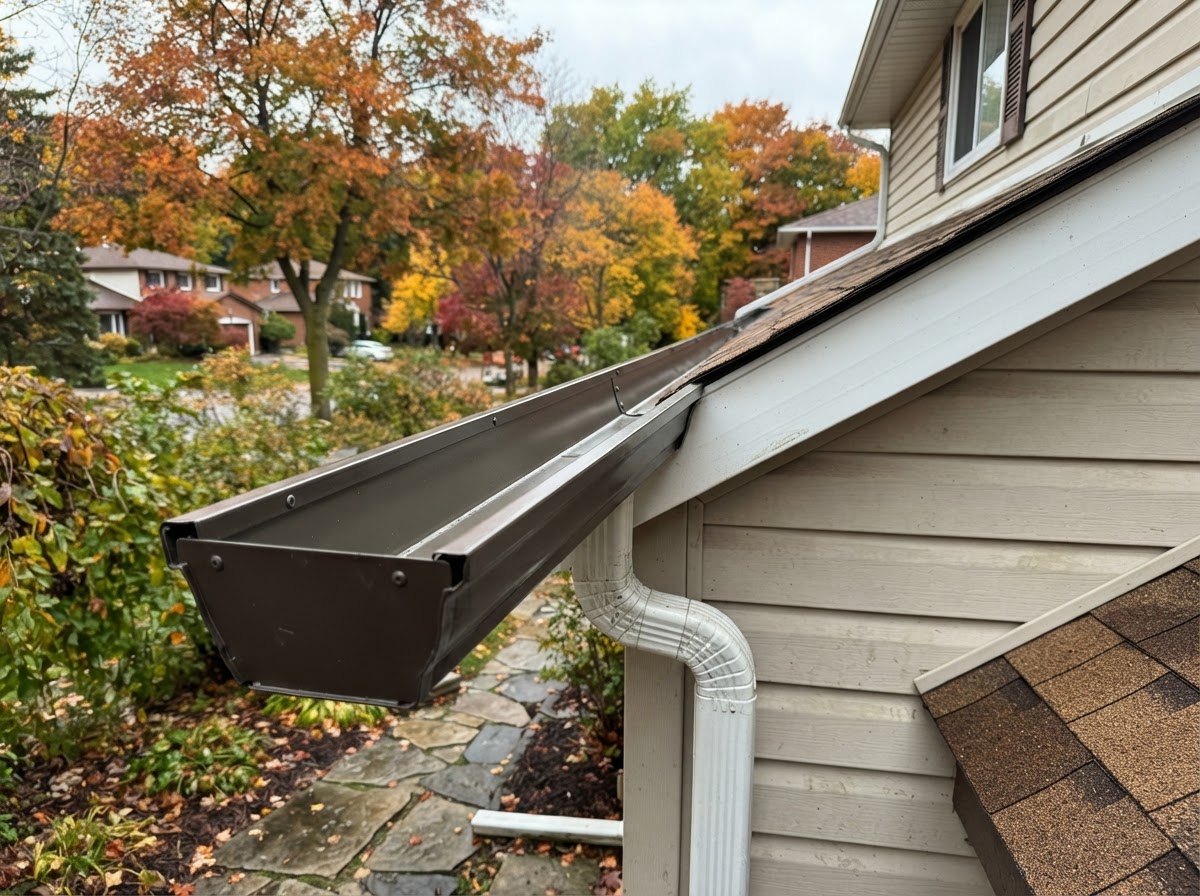
The first thing to understand is what a guard is and is not. A gutter guard is a screen, mesh, or solid cover that sits over the gutter opening and lets water in while keeping most debris out. The key word is most. No guard stops all debris, and every guard eventually needs cleaning, the question is how often and how badly. A good guard on the right home turns a twice-yearly cleaning into an every-12-to-18-months cleaning, and it dramatically reduces the volume of sludge that builds up between cleanings.
What a guard does not do is eliminate the downspout flush test, the inspection, or the eventual maintenance. Debris still lands on top of the guard, breaks down, and some of it works through. Fine particles wash through any mesh. Pine needles slide through wide mesh. Seeds sprout in the thin compost layer that forms on top of some guard types. The guard slows the problem, it does not end it, and a homeowner who installs guards and then never cleans the gutters ends up with a worse clog than they would have had without guards, because the clog is now under the guard where you cannot see it.
What guards do and do not do
- They reduce the volume of debris entering the gutter.
- They extend the time between cleanings, often by 50% or more.
- They do not eliminate cleaning, every guard eventually needs service.
- They do not self-clean, debris still builds on top and breaks down.
- They can hide clogs, a blockage under a guard is invisible until it overflows.
The guard types and how they fit York Region trees
Not all guards are alike, and the single biggest mistake we see is a homeowner buying the wrong type for their trees. The four main types each behave differently under oak leaves, pine needles, and maple seeds, and choosing well is the difference between a guard that works and one that makes things worse. Here is how each type performs in Richmond Hill conditions.
Reverse-curve (surface tension) guards
Reverse-curve guards use a solid hood with a curved nose that pulls water around the edge and into the gutter while shedding leaves over the front. They handle large oak leaves well because the leaves slide off the smooth surface, and they keep most large debris out. Their weakness is small debris, pine needles, seed pods, and flower parts can wash around the curve and into the gutter, and a fine shingle-granule layer can build up on the nose and slow water entry. They work well for homes with mostly large-leaf trees like oaks and maples, and less well for homes with pines or heavy seed drop.
Mesh and micro-mesh guards
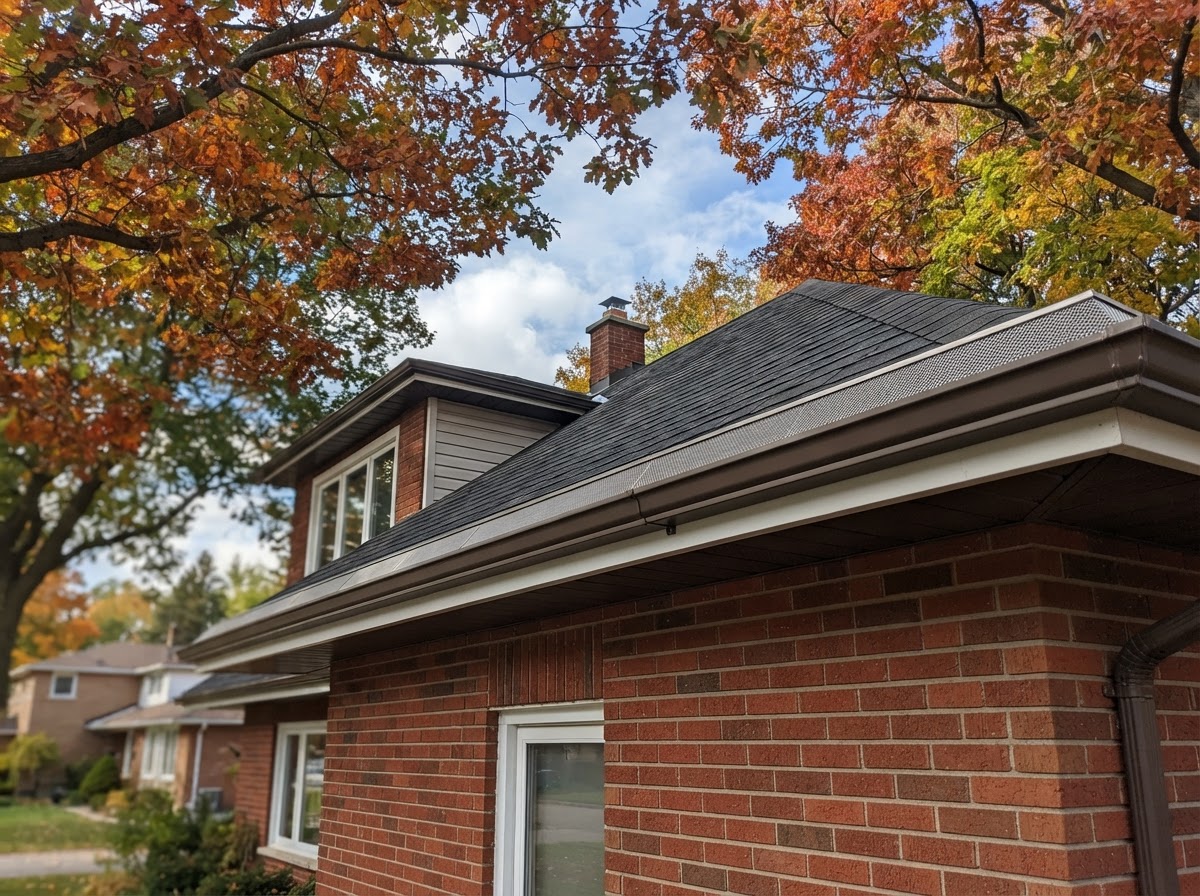
Mesh guards use a fine screen, often stainless steel micro-mesh, that stops debris while letting water through. Micro-mesh is excellent at blocking everything down to shingle grit and fine seeds, and it is the best choice for homes with a mix of tree types. Its weakness is maintenance load, fine debris can paste itself across the mesh and need a brush cleaning, and pollen can form a film that slows water entry in spring. For most Richmond Hill homes under mixed canopy, micro-mesh is the type we recommend most often.
Bottle brush and bristle guards
Bottle brush guards use a cylinder of bristles that sits in the gutter and catches debris while letting water flow through the bristles. They are simple and cheap, and they work reasonably well for large leaves. Their weakness is fine debris, needles and seeds lodge in the bristles and are hard to remove, and the whole brush eventually needs to be pulled and cleaned or replaced. We rarely recommend these for York Region homes because the maintenance load tends to be higher than the other types for the same benefit.
Foam inserts
Foam inserts sit in the gutter channel and let water through while blocking debris on top. They work for a season or two and then tend to clog with fine particles and biological growth, turning into a soggy mat that holds water against the fascia. In Richmond Hill's freeze-thaw cycles, that wet foam can accelerate fascia rot. We do not recommend foam inserts for York Region homes, the climate shortens their life and creates a hidden failure point.
Guard types at a glance
- Reverse-curve: great for large oak leaves, weaker for pine needles.
- Micro-mesh: best all-around for mixed trees, needs occasional brush cleaning.
- Bottle brush: cheap, high maintenance, not our pick for York Region.
- Foam inserts: not recommended here, freeze-thaw and clogging issues.
The Richmond Hill tree factor
York Region's tree canopy is the whole story for gutter guards. The mature oaks in Oak Ridges and Mill Pond drop large leaves and acorns in fall, and reverse-curve or micro-mesh handles those well. The pines and spruces on some lots drop fine needles year round, and those slide right through wide mesh and curve guards, so micro-mesh or frequent cleaning is the only answer. The maples drop winged seeds in spring that are surprisingly good at finding their way into any gap, and they sprout in the gutter sludge if they land there.
When we evaluate a home for guards, we look up first. What trees overhang the roof, how close, and what do they drop? A home with a single oak at the corner has a very different guard need than a home ringed by mature oaks and pines. We will tell you honestly whether guards make sense for your canopy, and which type fits your trees. We will also tell you if your gutters are better served by simply staying on a twice-yearly cleaning schedule, because for some homes that is the cheaper and more reliable answer.
Tree-type guide
- Oaks (large leaves, acorns): reverse-curve or micro-mesh, clean every 12 to 18 months.
- Maples (seeds, moderate leaves): micro-mesh, watch for spring seed sprouting.
- Pines and spruce (fine needles): micro-mesh only, or skip guards and clean twice yearly.
- Birch and elm (fine debris): micro-mesh, expect more top-side maintenance.
- Open lot, few trees: guards add little, a yearly clean is usually enough.
The freeze-thaw problem
York Region's freeze-thaw cycles add a wrinkle that homeowners in milder climates never think about. A guard that traps water or debris against the gutter, like a clogged foam insert or a mesh pasted with wet pollen, can freeze solid in a cold snap and block water entry entirely. When that happens, the gutter overflows exactly as if it were clogged, and the guard has made the problem worse, not better. This is why we are cautious about foam and about any guard type that holds moisture, and why we favor designs that shed water and debris rather than trapping them.
The freeze-thaw factor also affects installation. A guard clipped to the front edge of the gutter needs to survive ice loading, and a cheap plastic guard can crack in a cold snap and shed pieces into the downspout. We use durable, cold-rated materials for York Region installs, because a guard that fails in its first winter is not a saving, it is a repair bill.
The real cost and the real saving
Let us do the honest math. A micro-mesh guard install on a standard two-story Richmond Hill home runs roughly $12 to $22 per linear foot installed, depending on access and gutter condition, so a home with 200 feet of gutter is looking at $2,400 to $4,400. Against that, guards reduce your cleaning from twice yearly to roughly every 12 to 18 months, and they cut the per-visit cleaning time and sludge volume noticeably. Over five to seven years, the guard often pays for itself in reduced cleaning frequency, and it reduces the real risk of an overflow event that damages landscaping or floods a basement.
The catch is that guards are not free forever. A micro-mesh guard still needs a brush cleaning every year or two, and a reverse-curve guard needs the nose kept clear. If you treat the guard as "install and forget," you will eventually get a hidden clog that is worse than an open gutter clog, because you cannot see it forming. The homeowners who get the most value from guards are the ones who pair the install with a maintenance plan, clean the guards on a sensible schedule, and treat the guard as a reduction in maintenance rather than an elimination of it.
The honest cost math
- Micro-mesh install: $12 to $22 per linear foot installed.
- Cleaning frequency with guards: every 12 to 18 months, down from twice yearly.
- Payback: roughly 5 to 7 years in reduced cleaning cost alone.
- Risk reduction: guards lower overflow events that cause foundation and landscaping damage.
- Maintenance: guards still need a brush clean every 1 to 2 years, not zero.
When guards make things worse
We want to be honest about the failures, because they happen. The most common is a fine-mesh guard pasted with spring pollen that slows water entry so much that the gutter overflows in a heavy rain even though it is not clogged with leaves. The next is a reverse-curve guard under pine trees, where needles wash around the curve and fill the gutter invisibly until it overflows. The third is a foam insert that has turned into a soggy, frozen mat holding water against the fascia. In every case, the guard did not fail, the guard was the wrong choice for the tree.
This is why we never sell guards as a one-size solution. We walk your roof, look at your trees, and tell you whether guards help your specific home or whether you are better served by a reliable cleaning schedule. For some homes, the honest answer is that twice-yearly cleaning is cheaper, more reliable, and less risky than guards, and we will say so. The goal is the right solution for your home, not the sale.
Common guard failures
- Pollen film on micro-mesh: slows water entry, causes clean-guard overflow.
- Pine needles through reverse-curve: invisible fill until overflow.
- Foam freeze: wet foam freezes and blocks water entirely.
- Hidden clogs: debris under a guard is invisible until it overflows.
- Plastic cracking: cheap guards crack in freeze-thaw and shed into downspouts.
Our honest recommendation
For most Richmond Hill homes under mixed oak and maple canopy, we recommend micro-mesh guards paired with a cleaning every 12 to 18 months and a brush clean of the mesh as needed. For homes under heavy pine, we usually recommend skipping guards and staying on a twice-yearly cleaning, because the maintenance load on any guard type under pine is high enough that guards save little. For open lots with few trees, guards are rarely worth the cost, a yearly clean is plenty. We will give you the specific recommendation for your home after a look at the roof and the trees.
Whatever you choose, keep a cleaning on the schedule. Guards reduce maintenance, they do not end it, and a gutter that is never inspected is a gutter that will eventually surprise you with a problem you could have caught early. Protect your home with our gutter cleaning service, whether you add guards or not.
Ready to Book Your Gutter Guards in Richmond Hill?
When you pull into your driveway after a long day, we want your home to look completely revived. Our crew handles every detail, from the first phone call to the final walkthrough, so you never have to worry about ladders, streaks, or missed spots. We back every job with our 100% Happy Guarantee and we never nickel-and-dime you for the little things.
Tap to call now: Call (437) 261-2005 or request your free instant quote online. We serve Richmond Hill, Markham, Vaughan, Aurora, Newmarket, and King City.
Shine & Revive Inc. • 20 Thomas Legge Crescent, Richmond Hill, ON L4E 4W1 • (437) 261-2005 • contact@shineandrevive.ca